Image: NASA, Apollo 17, the Blue Marble (AS17-148-22727)
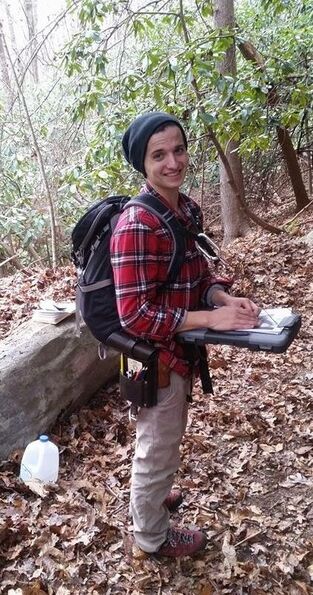
My name is Tony Gargano and I’m an isotope geochemist. I finished my B.S. in Geology at the University of North Carolina at Charlotte in 2016 and continued on to the University of New Mexico to learn from Zachary Sharp where I’m currently completing a Ph.D at the Center for Stable Isotopes. I was awarded a NASA AS&ASTAR Harriet Jenkins Graduate Fellowship in 2018 to supplement my dissertation with the guidance of Justin Simon at NASA JSC and the Center for Isotope Cosmochemistry and Geochronology. I am also a part of the Apollo Next Generation Sample Analysis Program (ANGSA) team.
I initially came to the Center for Stable Isotopes solely interested in geochemistry focused planetary science. I’ve since become increasingly devoted towards creating an interdisciplinary lab environment where natural sciences such as Geology, Biology and Archaeology can all benefit from stable isotope techniques. As a geochemist that enjoys living in the simplistic world of chemical thermodynamics – the notion of ‘it shouldn’t happen but biology can do it’ leaves me in amazement every day. I hope to one day create a lab environment such as the CSI where scientists from multiple disciplines can share their expertise.
In my personal research I’m deeply interested in developing novel methods as well as utilizing classical techniques to better understand how geological processes lead, and have led towards the Earth becoming a habitable planet. In this pursuit I study a wide range of terrestrial and extraterrestrial rocks and their chemical and isotopic compositions to understand the chemical evolution of planets towards habitable conditions for life. Luckily for me, it turns out that basically everything comes from rocks. Whether it is the food we eat, the water we drink, or the organic carbon that makes up our bodies – it all started off as a component within a rock at some period in time. Whether the time period of interest is 4.5 billion years ago during the accretion of planets, or a few hundred million years ago when eukaryotic life began to evolve – there are rocks that record the chemical evolution of the natural environment. I’m thankful to study such a broad topic as I very much enjoy teaching a holistic scientific curriculum.
My teaching philosophy largely stems from this interdisciplinary holistic scientific perspective. Isotope geochemistry and ecology solidifies the fact that all natural systems are intimately connected. To fully understand a natural system involves appreciating the magnitude of the individual components, biotic or abiotic. In the most classical example of measuring water for it’s oxygen isotope composition: an incredibly complex story is revealed indicating where that water came from, the path it took landward and how much rain out took place throughout its journey. This water is then drank by plants and animals which can be measured to tell us about how and when organisms respond to water stresses. These biotic systems also reveal their own intriguing stories, where carbon and nitrogen isotope compositions record the dietary niches of animals. These data can then be used to understand why certain organisms either thrive or fail during environmental stress.
Contact
Tony (Anthony) Gargano, Ph.D.
Postdoctoral Researcher, NASA Johnson Space Center (ARES)
Research Scientist, Center for Stable Isotopes, University of New Mexico
For outreach and professional inquiries please contact me via email at agargano@unm.edu

