From presolar grains to planetary surfaces
Image: NASA/JPL, Viking Orbiter 1 global mosaic of Mars (PIA00407)
I try to approach all of my projects, whether extraterrestrial-based or terrestrial-based, with the perspective of how geological processes can either aid, or hinder the chemical evolution of planets towards habitable conditions. The threads below are the current forms of that question.
Oxygen isotopes and the solar system’s initial composition
The Sun and the rocky material that built the planets do not share the same oxygen isotope composition, in both 17O/16O and 18O/16O. I work on models in which this diversity is inherited from presolar oxides delivered to the solar system’s parent molecular cloud, and on how the oxygen isotope composition of the galaxy evolved toward solar values.
Volatiles and halogens in planetary materials
Halogens and other volatile elements record how growing planetary bodies gained, lost and redistributed their volatile inventories. I measure chlorine and potassium isotope compositions and halogen abundances in chondrites and Apollo samples to trace these processes from the solar nebula through parent-body alteration.
Lunar samples and regolith processes
As part of the Apollo Next Generation Sample Analysis (ANGSA) effort I work on Apollo 16 regolith and impactites, including the provenance of impact glasses and the ballistic transport of ejecta across the lunar surface.
Experimental approaches to volatility
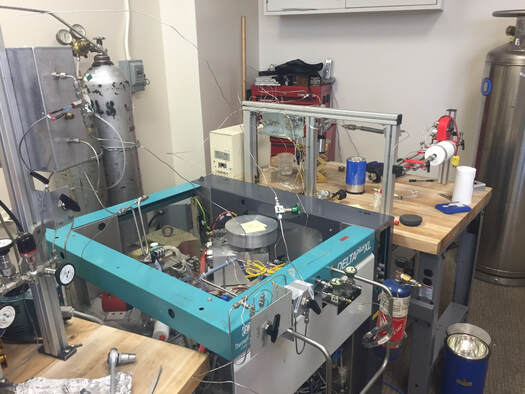
Interpreting isotopic records requires knowing what individual processes can and cannot do. I use isopiestic gas-melt partitioning experiments for the alkalis, triple silicon isotope measurements, and iron isotope fractionation during evaporation and condensation in enstatite chondrites to separate process signatures from inherited ones.