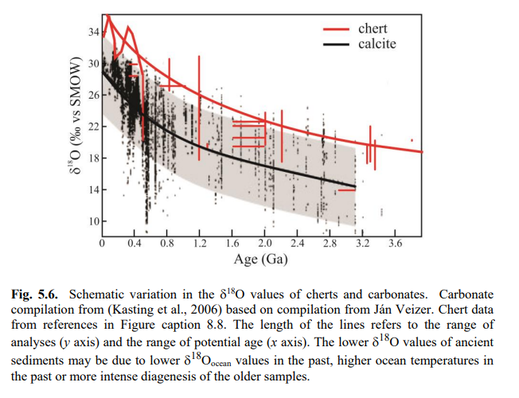
In looking in deep time we are left with the remnants of the past. Most of the time this isolates us to the use of ancient sediments which have lithified into solid rocks. The chemical and isotopic compositions of said rocks describe the physio-chemical environment in which they formed from. In regards to marine sediments, one particular area of interest is the temperature of the ancient ocean. Oxygen isotopes (oxygen atoms with differing numbers of neutrons which changes the mass of the isotope) are partitioned into materials as a function of temperature. Given this relationship and our experimental understanding of this partitioning we are able to estimate the temperature of the ancient ocean by measuring rocks which formed at any given time.
In this figure from Zach Sharp’s Principles of Stable Isotope Geochemistry – a secular trend of increasing oxygen isotope values of marine sediments (cherts and calcite) suggests that the ocean has slowly cooled throughout geologic time from around 70 degrees celcius (158 F!) in the Archaen to 25 degrees celcius today.


Leave a Reply