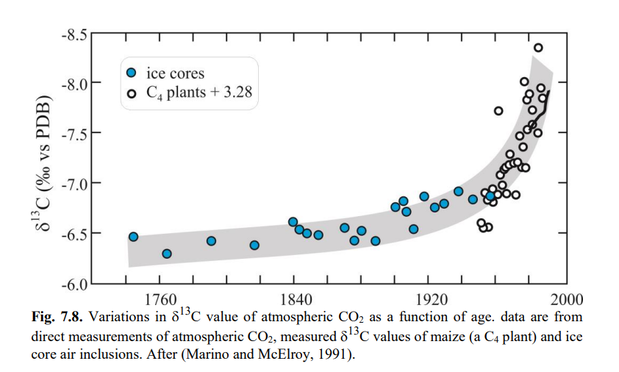
Natural systems tend towards equilibrium. For me, that means that given any environmental stress being placed upon a system – it will respond to it to reach equilibrium. As humans we constantly put environmental stresses on systems and as a result they tend to wane back towards a new equilibrium. Although our personal time-scales are exceptionally short relative to geologic time, our alteration of the environment is becoming increasingly easy to see, both physically and chemically. While there are numerous examples to physically observe this constantly changing equilibrium (i.e. beach erosion), chemical changes in the atmosphere point towards the increasingly important issue of climate change.
In this figure again from Principles of Stable Isotope Geochemistry – a marked effect of the decreasing the carbon isotope composition of the atmosphere has resulted since the industrial revolution due to the burning of fossil fuels. These fuels have very low carbon isotope values (around -25permil) and upon combustion, the released CO2 mixes with atmospheric CO2 (derived from the mantle of the Earth at around -6permil) and thereby decreases it over time as more fossil fuels are burned.


Leave a Reply